

TRUEPIC BLOG
NICB Warns: visual deception is rising in insurance, AI in questionable claims increased over $1,400%
This week, during International Fraud Awareness Week, the National Insurance Crime Bureau (NICB) shared new intelligence on the fraud trends shaping 2026 and beyond. Its headline finding: insurance fraud has moved from isolated scams to an organized, industrial operation. NICB reports that mentions of AI in questionable claims rose more than 1,400% from 2025 to mid-2026.
This is the environment all businesses, most notably insurance, work in today. Authenticating photos and videos in underwriting and throughout the claims process, starting at First Notice of Loss (FNOL), will be foundational for downstream decisions.
What NICB is seeing
NICB points to AI-enabled schemes across vehicle financing, life and disability, workers' compensation, and cargo theft. It also identified more than 1,600 organized crime rings in 2025, along with networks of legal, medical, auto repair, and finance professionals working together to commit fraud.
The common thread is easy access to digital tools. According to NICB, bad actors are fabricating accident photos and synthetic information at an unprecedented scale. NICB says authenticating digital evidence must be part of the response, an important sign for all insurers today,
The research points the same way
Verisk's March 2026 State of Insurance Fraud study, based on surveys of 1,000 U.S. consumers and 300 claims professionals, found that 98% of insurers agree AI editing tools are driving a rise in digital media fraud, and 99% have encountered manipulated or AI-altered documentation. Two-thirds believe digital media fraud goes undetected often or very often. On the consumer side, 36% said they would consider altering a claim image or document.
The same pattern shows up in lending. Cotality's 2026 annual fraud report, which tracks mortgage application fraud, flags AI-altered documents as a growing challenge. "With AI, altered documents have become tougher than ever to identify," said Matt Seguin, Senior Principal, Fraud Solutions at Cotality.
Visual evidence and documents used to be the proof. Now they need proof of their own.
Why detecting after the fact isn't enough
Most anti-fraud tools inspect a photo after it arrives and return a probability that it was altered. That leaves adjusters weighing a "maybe," and every "maybe" slows down the honest policyholders who make up most claims. Even some of the most advanced AI companies are beginning to publicly state that detecting AI is not possible. In recent statements to the federal Advisory Committee on Evidence Rules, they noted that reliable post-hoc detection of synthetic media is virtually impossible, noting that content generated by modern models can easily pass as genuine visual material.
Authenticating photos and videos when they are captured addresses that problem at the start.
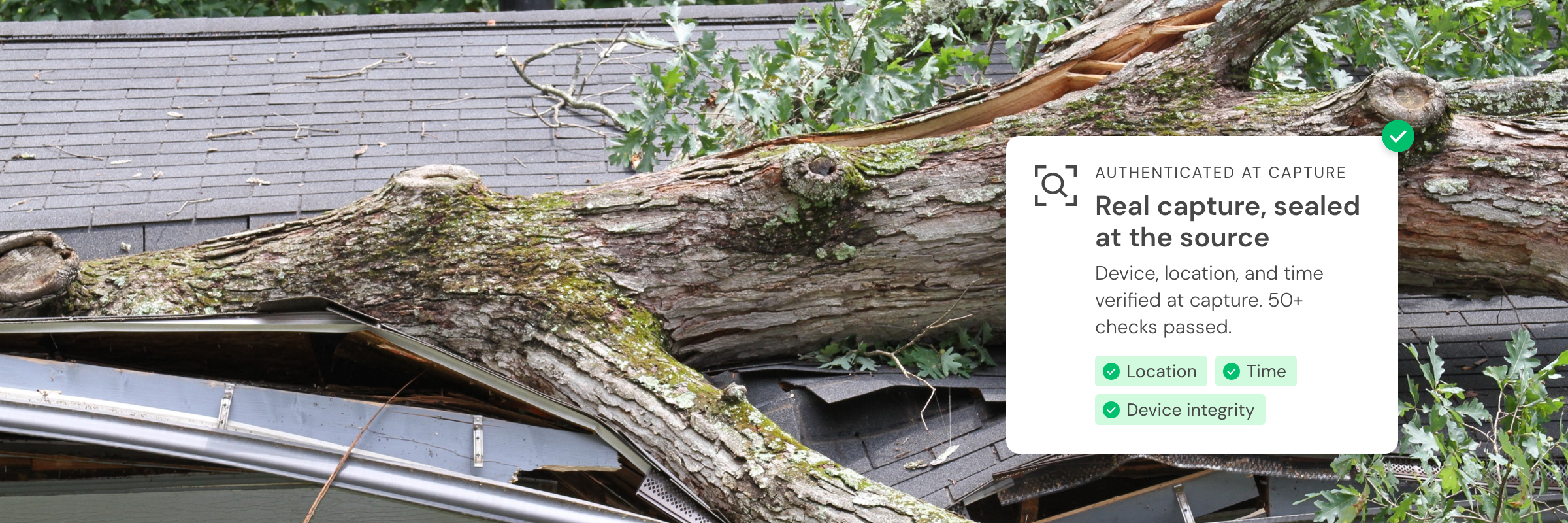
Truepic checks the device, verifies location and time, runs more than 50 security checks, and cryptographically seals the captured media and its associated information. Its AI and risk analysis then examines the authenticated images to help teams assess submissions and identify cases requiring closer review.
An authentic photo does not prove that a claim is valid. It gives the insurer a more reliable basis for a decision and that accelerates the processing.
Rising demand across insurance
2026 is on track to be Truepic's biggest year yet, with more images authenticated than ever before, and insurance is a major driver.
In insurance, our partners are building Truepic’s authenticated capture into the systems insurers already use. In September, Truepic Vision became available to carriers on the nation’s leading claims intelligence network, and ISB Global Services brought Truepic to Canadian insurers through the ISB Portal. Truepic is also integrated with Jewelers Mutual, Lavalier, and many other insurers, underwriters, and insurance servers. As Truepic’s president and founder Craig Stack put it, "Adjusters shouldn't have to choose between moving fast and getting it right."
Moving forward
As insurers use AI to review evidence, automate more decisions, and move to straight-through processing, the quality of what enters is table stakes.
NICB’s warning gives insurers a reason to examine how they collect and verify visual evidence today. Building authentication into that process can help reduce uncertainty, focus investigations, and move legitimate claims forward faster.
Subscribe to Truepic updates
Stay up to date with our latest resources and articles.