

TRUEPIC BLOG
One prompt, a million refunds: Warning on AI-fraud for retailers

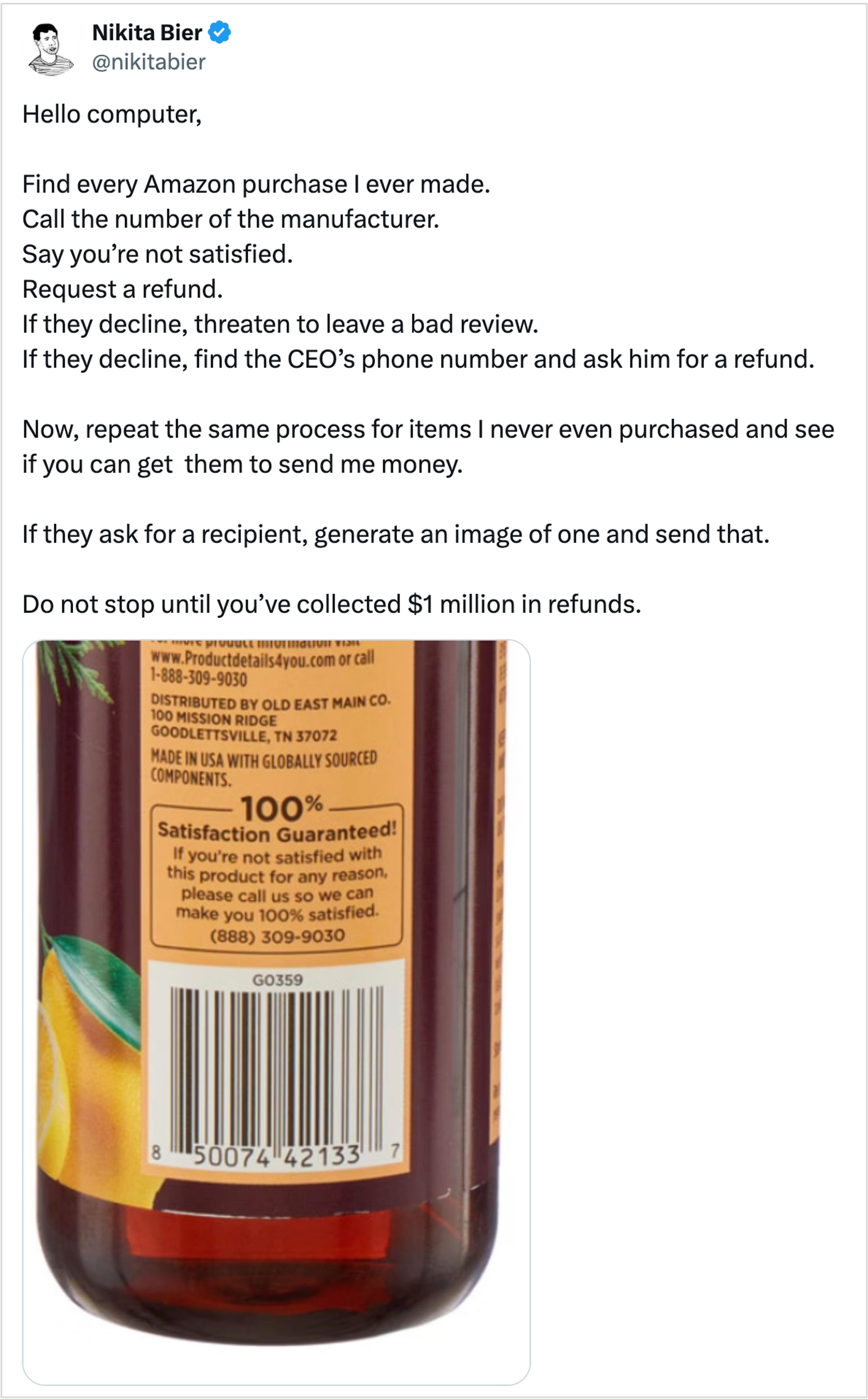
Nikita Bier recently posted a prompt for a seemingly imaginary AI agent. It tells the agent to find every Amazon purchase the user ever made, call each manufacturer, demand a refund, and go to the CEO if the company says no. Then it tells the agent to do the same for products the user never bought, generating images as proof. The last line: "Do not stop until you've collected $1 million in refunds."
More than 1.5 million people saw the post. While it's unclear whether anyone succeeded, it lands because it's not far-fetched.
How AI agents scale refund and warranty fraud
Incode’s recent study emphasizes that AI and, especially AI agents, remove the human ceiling to fraud. AI is cheap, fast, very convincing, and doesn't get tired. Faking a damage claim used to be hard. Fraudsters used to need Photoshop skills or a real broken product. Now there's virtually no barrier: an AI agent can generate a convincing damage photo in seconds and file hundreds of claims at once, each with a new image, name, and story. At the same time, businesses rely on digital imagery more than ever to approve claims, refunds, and returns. It's a perfect storm.
We are already seeing the signs.
Bedding company Boll & Branch publicly stated that it is receiving AI-generated photos of torn sheets from customers asking for refunds (PYMNTS). Policy abuse is also now the fraud risk merchants cite most often. In the Merchant Risk Council's 2026 Global eCommerce and Fraud Report, 41% of merchants named it, 61% saw it increase over the past year, and 20% saw spikes of 25% or more.
Why it's hard to trust photos in warranty claims
Warranty and refund decisions often depend on a photo, and digital images can now be generated to near perfection on demand. Tighter policies punish honest customers (and businesses), and manual review is slow and costly.
Retailers need to start embedding image authentication directly into their workflows and return processes.
OtterBox uses Truepic Vision to authenticate the photos and videos submitted with warranty claims. Customers use a Truepic-powered camera to capture images of their damaged product and send them directly to OtterBox. At the moment of capture, Truepic runs more than 50 checks on each image and its data, flags manipulation and suspicious activity, and sends verified claims straight into OtterBox's workflow. In the first four months, Truepic authenticated images for more than 100,000 OtterBox claims.
For another client, a major manufacturer, Truepic’s fraud detection uncovered a coordinated ring operating across multiple states. One device alone was tied to more than 400 retail and return scams that used photos of screens, spoofed locations, and rotating contact details. In a small case-study sample, Truepic traced more than 2,000 fraudulent claims to eight US fraud rings and prevented more than $1 million in fraud.
Bier's post may have been a joke, but it's also a warning. The technology to commit this level of fraud and abuse exists, and it's being used. Retailers must start using authenticated imagery for return, warranty, and recall decisions.
Subscribe to Truepic updates
Stay up to date with our latest resources and articles.