

TRUEPIC BLOG
Dun & Bradstreet and Truepic: Securing business identity at scale with visual risk intelligence
.png)
Executive summary
Visual fraud, often driven by AI, is eroding trust in digital business processes, including business onboarding, vendor onboarding, and third-party risk management, just as the global economy has embraced digitalization. AI tools creating deepfakes and synthetic media allow bad actors to deceive traditional checks at scale, creating real financial and systemic risk. In this complex global economy, Dun & Bradstreet’s D-U-N-S® Number remains critical infrastructure for business verification and legal entity verification worldwide. As commerce becomes faster and more digital, preserving confidence in business identity becomes essential for trade, finance, compliance, and government operations.
To meet this challenge, Dun & Bradstreet has strengthened the D-U-N-S application process by embedding authenticated image and data capture through its partnership with Truepic. Virtual inspections using authentic media verify that submitted photos or videos are genuine, captured at the correct time and place, and free from manipulation, stopping onboarding fraud and application fraud before they enter the Dun & Bradstreet ecosystem.
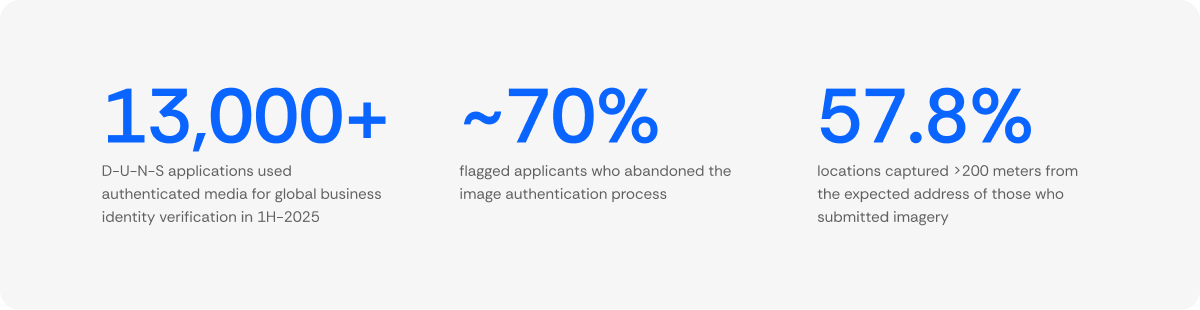
Early results from more than 13,000 applications and over 7,000 authenticated images demonstrate faster initiation of inspections as quickly as 3 seconds after receipt, successful global reach in over 87 countries, and clear deterrence of suspicious behavior, with nearly 70% of flagged applications abandoning the process. This secure environment helps prevent suspicious or fraudulent data from entering the Dun & Bradstreet ecosystem. The outcome is a more secure, scalable, and trusted path to business verification, reinforcing the D-U-N-S system as a cornerstone of trust in an AI-driven economy.
Problem space: AI-enabled fraud
Accelerated by AI, visual risk and synthetic media fraud are on the rise. Generative AI and synthetic deepfakes now enable bad actors to create fake photos, videos, and even voices that can bypass traditional security checks. This surge comes as businesses and the global economy speed up digital transformation, creating a troubling paradox: companies depend on digital content more than ever, yet they can’t fully trust what they see or the data behind it. If unchecked, this growing gap between reliance and trust could threaten individual businesses and broader economic stability.
This risk is real and backed by credible data. In 2024, an estimated 105,000 deepfake attacks occurred globally, roughly one every five minutes, and this trend is climbing. AI-driven fraud has already fueled high-profile incidents involving millions in losses, state-sponsored corporate espionage, and scams targeting vulnerable populations such as the elderly. Deloitte estimates AI-enabled fraud against businesses will exceed $40 billion by 2027.
The D-U-N-S Number: Foundational to the global economy
The scale of this challenge highlights why authenticity in digital processes isn’t just a security feature, it is critical infrastructure for the global economy. The D-U-N-S Number provides the foundation for verifying the identity, existence, and legitimacy of business verification, legal entity verification, and counterparty verification worldwide. From supply chains to lending decisions, from government contracts to cross-border trade, the D-U-N-S process forms the trust layer that underpins global commerce.
.png)
Millions of businesses across every industry rely on accurate entity verification to operate confidently in a connected world. Authenticity ensures transparency, reduces fraud, and builds trust in transactions that span borders and sectors. The D-U-N-S process is recognized and used by governments, financial institutions, and businesses of all sizes globally. It supports compliance, third-party risk management, counterparty risk controls, operational efficiency, and growth strategies, while enabling interoperability across digital ecosystems. In an era where AI amplifies both opportunity and risk, Dun & Bradstreet is committed to strengthening the D-U-N-S process as the cornerstone of trust.
Bolstering D-U-N-S with image and data authentication
The D-U-N-S Number is designed to keep pace with the speed of global commerce, making digital tools essential for reducing friction and driving efficiency. Yet this reflects a broader challenge for businesses worldwide: how to embrace digital transformation without compromising security, especially in the AI era. To address this, Dun & Bradstreet partnered with Truepic to embed image and data authentication directly into the D-U-N-S application process. Through Truepic’s Vision platform, Dun & Bradstreet verifies applicants by ensuring that submitted digital content, such as images or videos of the applicant’s business, is authentic and anchored to verified capture data.
How it works
To obtain a D-U-N-S Number, a qualifying business must apply and validate its authenticity. As part of this process, Dun & Bradstreet leverages Truepic’s technology to allow applicants to self-report business information while submitting supporting images. Truepic ensures the integrity of this content at the moment of capture by confirming that the image was created by photons hitting a camera lens, applying a trusted timestamp aligned to universal time, and verifying geolocation and device orientation accuracy. This approach delivers a secure, transparent, and efficient way to establish trust in a digital-first world.
Beyond image capture, Truepic’s technology performs over 50+ fraud-detection checks to identify threats such as rebroadcast attacks (taking photos of a screen while spoofing metadata), malware injections, or geospoofing. It also verifies encryption both in transit and at rest, and conducts reverse image searches across private and public databases to confirm whether submitted content already exists online. Each image is cryptographically sealed using open standards such as the Coalition for Content Provenance and Authenticity (C2PA), making it tamper-evident over time. These safeguards are built into the Truepic Vision workflow, now embedded in the D-U-N-S verification process. The impact is transformative (or maybe clear): faster application processing, greater confidence in authentic data, and early detection of fraudulent or suspicious submissions, strengthening trust at every step.
The Vision platform offers expanded capabilities to enhance intelligence and further reduce visual risk through its Risk Network. This network enables Dun & Bradstreet to access shared insights drawn from across the financial services industry, creating a broader layer of protection for third-party risk management. By leveraging this collective intelligence, Dun & Bradstreet can identify device-level risk alerts that flag suspicious behavior early, especially by serial bad actors, fraud rings, and other large-scale deception efforts. These advanced signals allow the company to detect and respond to potential fraud within the D-U-N-S process.
Why is authenticity necessary in the D-U-N-S process?
Business and commerce, including both B2B and government-to-business transactions, are fundamental drivers of the economy, and they depend on trust in the legitimacy of business entities. Business verification is essential for a broad spectrum of decisions, including supplier verification, vendor due diligence, corporate due diligence, and counterparty risk controls. Dun & Bradstreet brings over 180 years of experience collecting data to confirm the legitimacy of businesses that form the backbone of the economy.
Over time, Dun & Bradstreet has evolved its verification approaches: moving from onsite, in-person business verification to phone verification, and now to AI-driven authentication using photos, video, and other multi-modal data. Today, many small businesses may not respond to phone calls or may have missing or inconsistent documents, so they prefer self-service applications to update their information. These trends have led to more technology-driven, self-service business identification processes. This shift allows businesses to respond across time zones and on their own schedules, driving a 12-fold increase in onboarding volume and a reduction in the time required to assign D-U-N-S Numbers.
Outcomes and impact
Delivery
Dun & Bradstreet has integrated image and data authentication into the D-U-N-S verification process to strengthen trust and reduce fraud. Applicants with incomplete forms or flagged details may be asked to confirm their status using authenticated data and imagery. Those selected will receive a “smartlink” via SMS or email, directing them to a provenance-based digital camera for self-inspection via the Truepic Vision platform.
In the first half of 2025, Dun & Bradstreet deployed this technology to more than 13,000 D-U-N-S applications worldwide. Of these, 4,321 applicants submitted authenticated digital imagery from over 87 countries to support their verification. Notably, nearly 70% of applicants asked to provide authenticated imagery either did not respond or abandoned the process; these are referred to as “walkaway” inspections. On average, verification requests were delivered through the Vision platform in three seconds, enabling rapid and secure processing at scale.
.png)
Speed
Applicants receive a secure smartlink that allows them to self-inspect their office or business at their convenience. Through this link, they capture images using the Vision platform as part of business address verification. Before the camera activates, the platform runs a series of security and attestation checks, completed in seconds, to ensure authenticity. Applicants then opt in to share the associated data with their D-U-N-S application, making the process both secure and highly efficient.
Inside the controlled camera application, applicants capture images and videos tied to their business, supporting business entity verification. Guided prompts ensure they meet application requirements, such as photographing their business premises, the front entrance, and signage at commercial locations, while also answering key questions, such as the business’s full legal name and ownership status. On average, applicants took 3.8 days to return images and survey responses to Dun & Bradstreet for review, though the median turnaround time was 1.9 days. Each submission included approximately 1.65 images per inspection, totaling more than 7,000 images across all applications.
Analysis
The Vision platform prevents fraud at the source, ensuring only authentic data enters the D-U-N-S process for business verification. Its controlled capture process blocks manipulated or compromised operating systems, preventing untrusted data from ever completing the workflow. Many “walkaway” inspections, where applicants failed to respond or could not access the camera, may have involved malware, geo-spoofing, or manipulated software designed to falsify data and locations. As with other deterrence methods, this safeguard preemptively blocks bad actors. While its full impact may be invisible, it is critical to protecting digital workflows from exploitation by AI-driven fraud.

Once applicants confirm and attest to the integrity of their data and device, Truepic’s fraud detection tests dig deeper to identify suspicious activity associated with the image and its metadata. Location accuracy is vital to the D-U-N-S process and business address verification, which verifies a business’s existence. Ensuring that images of a business, its signage, and any other required elements are captured at the exact address listed on the application is essential. The Vision platform flags any discrepancies instantly.
In this case study, the Vision platform revealed that 57.8% (2,498 of 4,321) of virtual inspections contained images captured more than 200 meters from the expected address, and 11% were taken 1000 to 5000 km away. While distance alone does not confirm fraud, these alerts provide critical intelligence that strengthens the D-U-N-S process and informs customers worldwide.
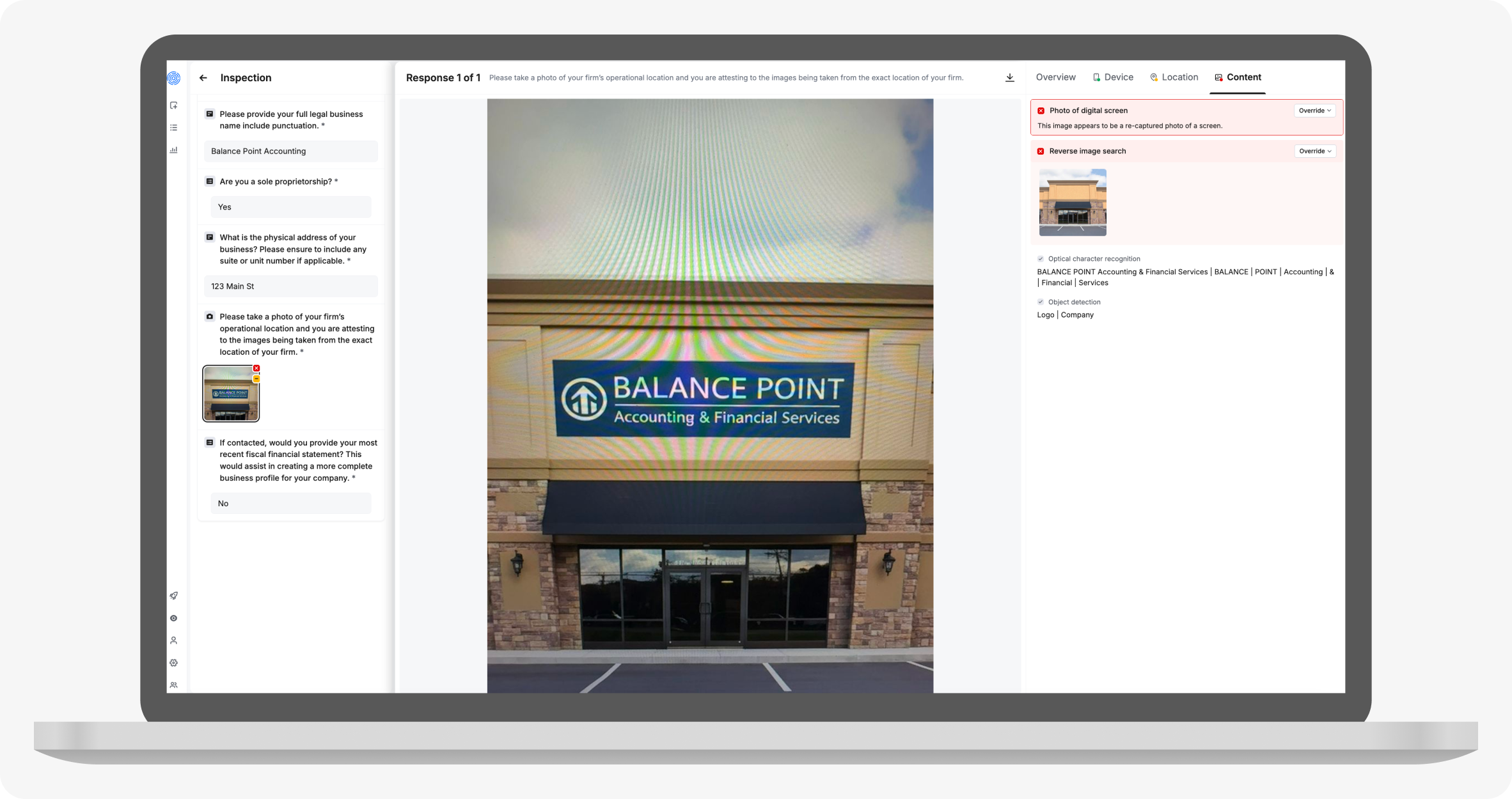
Beyond data authenticity, the platform ensures image authenticity, preventing bad actors from pairing genuine metadata with falsified visuals. For example, it flags rebroadcast attacks, where a photo of a computer screen could falsely depict a business location while still carrying authentic metadata. The system’s machine learning and computer vision algorithms detect anomalies such as Moiré patterns and other indicators of picture-of-screen or picture-of-picture manipulation.
These checks are reinforced by reverse image searches across multiple databases, as well as Optical Character Recognition (OCR) and Object Detection Recognition (ODR), adding multiple layers of verification and intelligence. This redundant, cross-checking approach ensures that only authentic data and imagery flow through Dun & Bradstreet, delivering confidence and trust.
Conclusion
As visual fraud and risk continue to reshape how businesses operate digitally, the bar for establishing and defending trust rises. By integrating image and data authentication into business verification processes, Dun & Bradstreet has modernized a critical trust mechanism, bolstering its reach and utility in the AI era. The result is a system that deters fraud, surfaces risk earlier, and strengthens confidence in business identity worldwide. In a digital economy where seeing is no longer believing, verifiable authenticity must become the standard that sustains commerce.
Subscribe to Truepic updates
Stay up to date with our latest resources and articles.