

TRUEPIC BLOG
Fraud vs. friction: the two F-words every carrier knows
Authored by Craig Stack, Truepic’s President & Co-Founder
The new shape of claims fraud
Every claims leader I talk to is managing two pressures that pull in opposite directions. The first is fraud, and over the past two years it has changed shape.
Generative AI tools can now add a dent, change a date, or create damage that never happened. In Verisk’s 2026 State of Insurance Fraud study, 99% of claims professionals surveyed said they had encountered manipulated or AI-altered documentation.
Research on insurance fraud suggests opportunistic behavior is more common than organized schemes: a policyholder inflates a real loss, reuses an old photo, or exaggerates damage. In my view, plenty of people who would never shoplift see a claim as a negotiation with a large company. Generative AI has made it easier to act on that instinct.
The Verisk study shows how far that has gone. It found that 36% of consumers would consider digitally altering a claim photo or document to strengthen their case, even if it broke the insurer’s rules. And 13% of all consumers surveyed said it’s acceptable to create images of damage that never occurred.
The other side of the ledger: the claims experience
Fraud is only half of what claims leaders are weighing. Delivering an excellent customer experience has always been a top priority in insurance, and for good reason. The claim is when a policyholder finds out whether the promise they’ve been paying for holds up, and customers who go through a slow or frustrating process don’t tend to stay.
J.D. Power’s 2024 U.S. Auto Claims Satisfaction Study, based on responses from almost 10,000 auto insurance customers, found that 80% of respondents who reported a poor claims experience had already left their carrier or said they planned to.
Not every customer wants the same process, either. In the same study, 32% of customers in the baby boomer generation and older said they weren’t comfortable using digital tools for an entire claim.

Two options that both cost something
Put those pressures together and many carriers feel boxed into a choice between two imperfect options.
The first is to verify the traditional way: send an adjuster or inspector, or escalate questionable claims to SIU. That catches more fraud, but it’s slow, expensive, and frustrating to honest policyholders.
The second is to keep the process as frictionless as possible: accept the photos the policyholder submits and pay quickly. That protects the customer experience, but it means relying on evidence that is increasingly easy to fake.
Industry expectations suggest carriers are drifting toward the first option. Looking three to five years out, insurers in the Verisk study expect tighter documentation and proof-of-loss requirements for claimants (45%) and longer claim cycle times (35%).
In practice, that means more documentation and longer waits for payment. In the same study, 36% of consumers worried that legitimate claims could be delayed or denied if their documents were mistakenly flagged as altered. Honest customers shouldn’t pay the price for fighting fraud.
Why the compromise doesn’t hold
Most carriers try to split the difference. They accept submitted photos, run them through detection tools or a reviewer’s judgment, and escalate what looks off. That compromise depends on someone being able to tell a real photo from an altered one, which is getting harder.
At a recent webinar with Verisk, we showed an audience of claims and SIU professionals a real vehicle damage photo and asked whether it was real or modified. 88% said it was modified. These are people who review claim photos for a living. The industry data reflects the same uncertainty: only 32% of insurers in Verisk’s study said they were very confident they could identify a deepfake.
When after-the-fact review is unreliable in both directions, it misses some fraud and flags some honest claims.
The assumption underneath the tension
The tension between fraud and friction rests on an assumption that rarely gets examined: that any added verification step burdens every claimant equally.
It doesn’t.
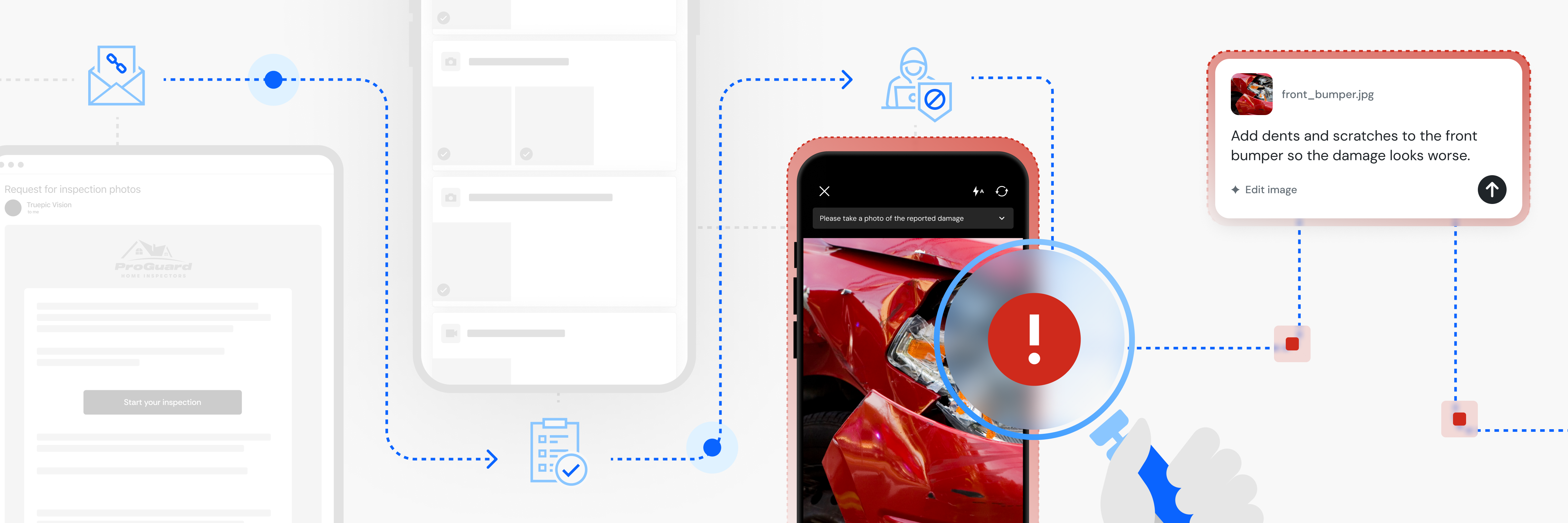
Consider what a request to capture live photos looks like to two different people. For a policyholder with a genuine loss, it’s a text message with a link. They walk around the vehicle or property, follow the prompts, and finish the request in a few minutes.
For many, that’s faster than they expected, and it gets the claim moving sooner.
For someone who planned to submit a photo from an earlier accident, or an image that was edited, the same request can act as a deterrent. They can’t upload the photos they already have, and the time, location, and device behind each new photo are recorded when it’s taken. Many of them never complete it.
What the walk-aways tell us
When a claimant receives an inspection request and never completes it, we call that a “walk-away.” To understand how often that happens, we looked at a sample of our own customer data in auto warranty claims, covering more than 500,000 inspection requests. About 1 in 7 inspection requests were never completed.
At first glance, that looks like the friction problem carriers worry about. If 14% of customers don’t finish, it’s natural to assume the process is asking too much of them, and honest claimants are giving up in frustration.
The data told a different story. Most incomplete requests showed patterns suggesting claimants couldn’t or wouldn’t provide live photos of the reported loss, rather than difficulty with the process. We call these suspicious walk-aways, and we estimate they make up 85 to 90% of the incomplete requests we reviewed.

That number sounds high, and it’s an estimate, not a count of confirmed fraud. We didn’t get there by assuming the worst. We looked at what actually happened inside each incomplete request.
Some people genuinely struggle with technology, which is why a web-based option and a fallback path matter. But the requests behind our estimate kept showing the same three indicators.
1. The request is opened, then abandoned
The claimant opens the link within a minute of receiving the text, so they’ve clearly seen it. Then nothing is ever captured, and the request sits untouched until it expires.

2. Photos are captured and deleted, over and over
Photos are taken and deleted in quick succession, sometimes many times in a few minutes. This often points to someone trying a location-spoofing app and having each attempt blocked.

3. The claimant asks to skip live capture
The claimant contacts the carrier to ask whether they can just send the photos they already have, or whether new ones are really necessary.

Each of these walk-aways also changes the economics of the claim. An inspection that’s never completed can close out before a field inspection, more adjuster time, or an SIU investigation is spent on it, which frees those resources for the cases that truly need them.
Where carriers go from here
Three changes can help.
1. Verify at capture, not after submission. Reviewing photos after they’re submitted asks adjusters to judge evidence they can no longer take at face value. When photos are captured live, with the time, location, and device recorded as they’re taken, the evidence arrives with its origin already established.
2. Ask for live capture where there’s a reason to. Detection tools are good at flagging a photo whose date or location doesn’t match the reported loss, but a flag is only a starting point. Use those flags and other risk signals to decide which claims need live, authenticated photos, instead of adding the step to every claim.
3. Treat walk-aways as a signal, not just a drop-off. Track how often inspection requests go incomplete, look at what happened inside them, and keep an accessible fallback for customers who genuinely need help. The rest often tells you something about the claim.
Fraud and friction will keep pulling in opposite directions. Carriers that move verification to the point of capture can guard against manipulated media without making every policyholder pay for it in time and frustration.
We explored this with Verisk in the webinar From Signal to Resolution: A Layered Approach to Claims Evidence. Watch the full session.
Subscribe to Truepic updates
Stay up to date with our latest resources and articles.