

TRUEPIC BLOG
AI fraud tops a survey of emerging claims risks
For years, insurance experts noted lawsuits were the primary cost driver. Juries awarding bigger payouts, outside investors funding lawsuits for a cut of the winnings, and people trusting big companies less than they used to. Insurers called this 'social inflation.’
At this year's RIMS conference, the experts suggested this is no longer the largest worry.
CorVel surveyed risk managers on what will drive claim costs higher over the next three to five years. Fraud using AI and questions about whether data can be trusted came in first, named by 32% of respondents. Social inflation ranked second at 25%. It is a quiet but significant shift: the industry's risk professionals now see fraud, rather than litigation, as the greater threat to their financial results.
This matches concerns from other financial service industries too.
It is already showing up in the numbers. Admiral, one of the United Kingdom's largest motor and home insurers, detected £86.8 million in fraudulent claims in 2025, up 71% from £50.9 million the year before. Its investigators found a car photo reused with an altered number plate and a designer watch made to look damaged with an AI filter. This is not exotic fraud. It is cheap, fast, and increasingly difficult to distinguish from the real thing.
Here is the tension insurers face: they want to use AI to review claims faster, shorten claim cycle times, and flag suspicious activity for investigation. Some also want to process straightforward claims without manual review. Yet a third of respondents in the CorVel survey cited privacy, security, compliance, and model risk as their biggest barrier to using AI effectively in claims. For claims that rely on photos and videos, there is another question: how can an insurer trust the evidence it is asking AI to assess?
That gap is the real story, and it extends far beyond insurance. It appears anywhere a photo or digital content substitutes for a human inspection.
The industry has typically fought this after the fact through better fake image detection and more layers of review. Those measures are necessary, but they are always a step behind. Insurers are trying to detect yesterday's fakes with today's tools while methods for creating fakes improve even faster.
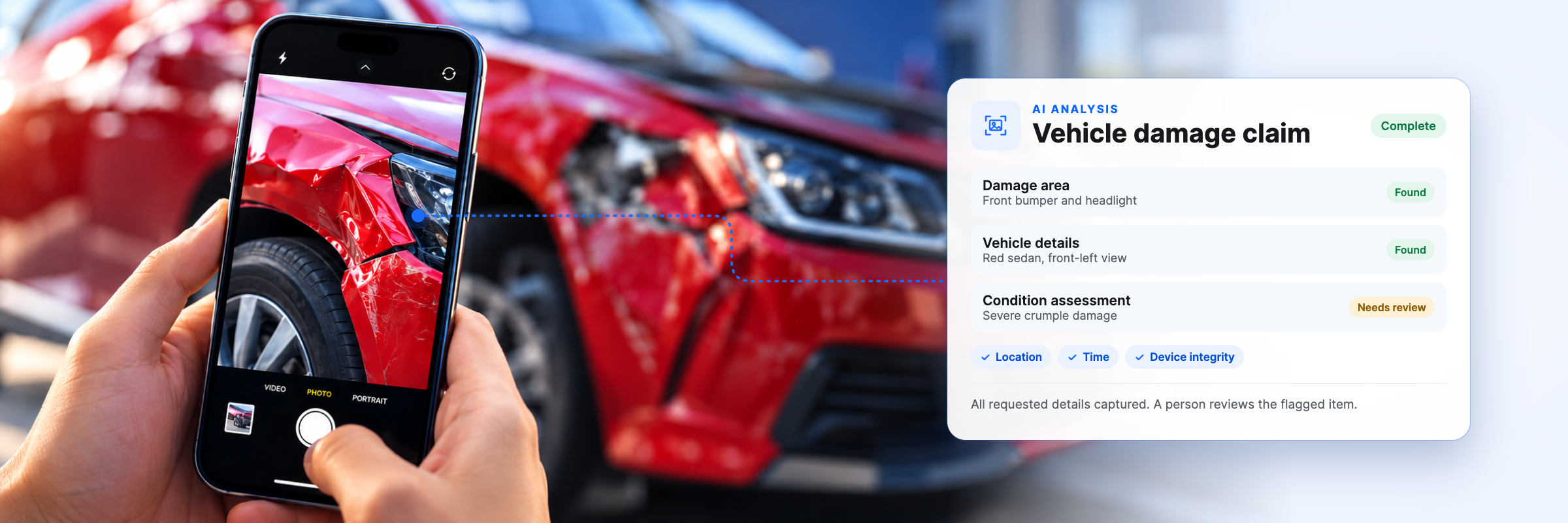
The more durable solution is to stop trying to separate truth from fiction after a photo exists and instead verify it the moment it is captured. An authenticated photo or video whose source, device, time, location, and editing history can be confirmed does not require adjusters to become better at spotting fakes. It keeps fake evidence out of claims investigations entirely, and meaningfully reduces inspection fraud before it reaches underwriting. In Canada, ISB Global Services partnered with Truepic to provide this approach and now allows insurers to request authenticated photo and video inspections through its existing portal.
Risk managers have now said, in their own numbers, that unreliable information is a greater problem than the litigation pressures they have spent a decade fighting. That is not a reason to slow the use of AI in claims. It is the strongest argument yet for making sure AI is looking at something real.
Subscribe to Truepic updates
Stay up to date with our latest resources and articles.